
HiRoxHiRox
← Training guide

TRAIN WITH A PURPOSE

HYROX Complete

Connect the work. Build station capacity.

Run + stationsTransitionsRace practice
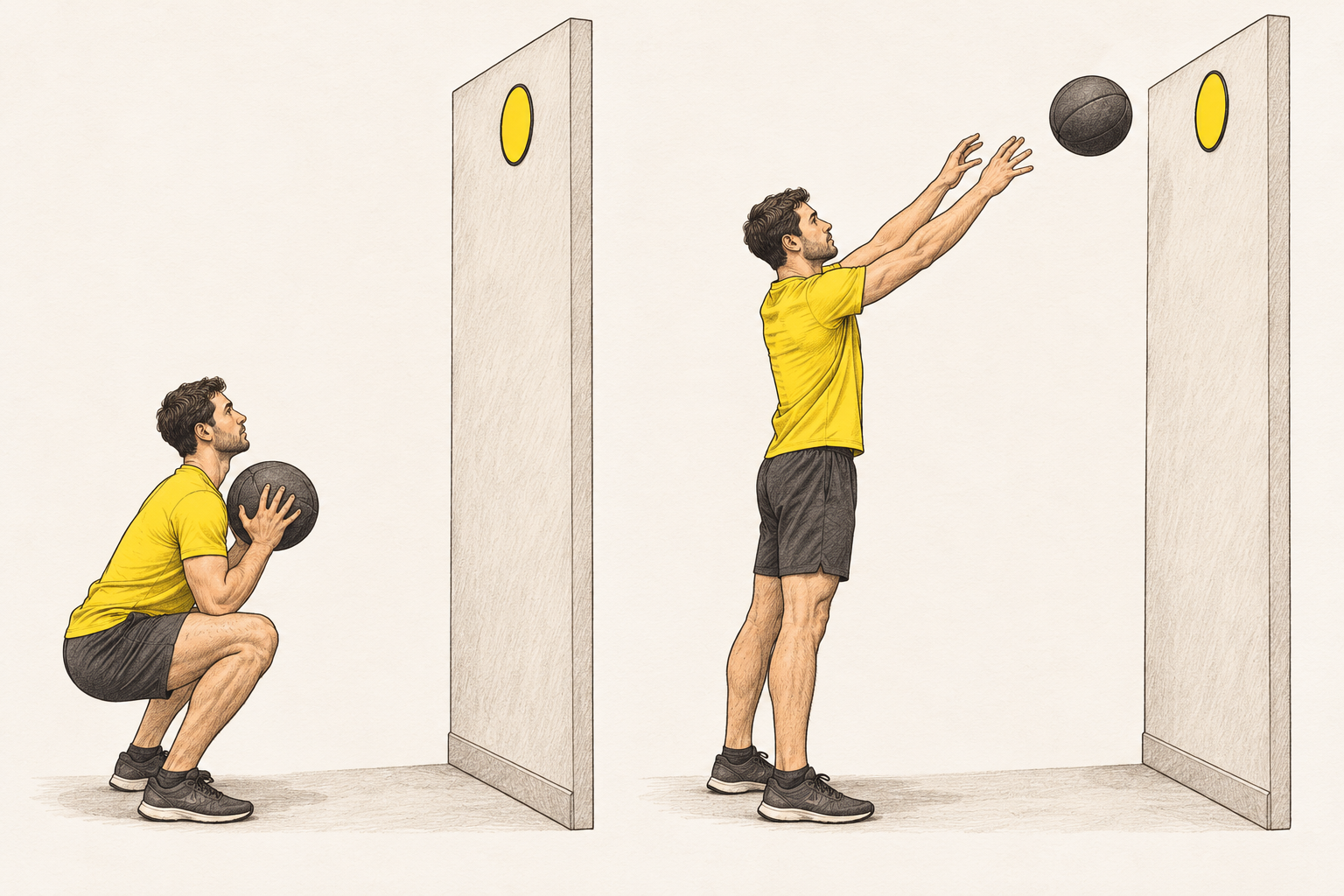
Instructional illustration showing the squat and upward throw phases of a wall-ball repetition.

PUT THE PURPOSE INTO PRACTICE

Three example workouts.

Source-based workouts. Adapted to your time and equipment.

Session time
Equipment

45-minute examples · Full HYROX gym · Regular routine, familiar stations and comfortable 20–40-minute running. Warm-up and cooldown included.

SAMPLE WORKOUT 01

Lunge, then find your run

Practise returning to running after leg work before adding other stations.
45 min · Warm-up and cooldown includedRun–station practice · about 6–8 out of 10
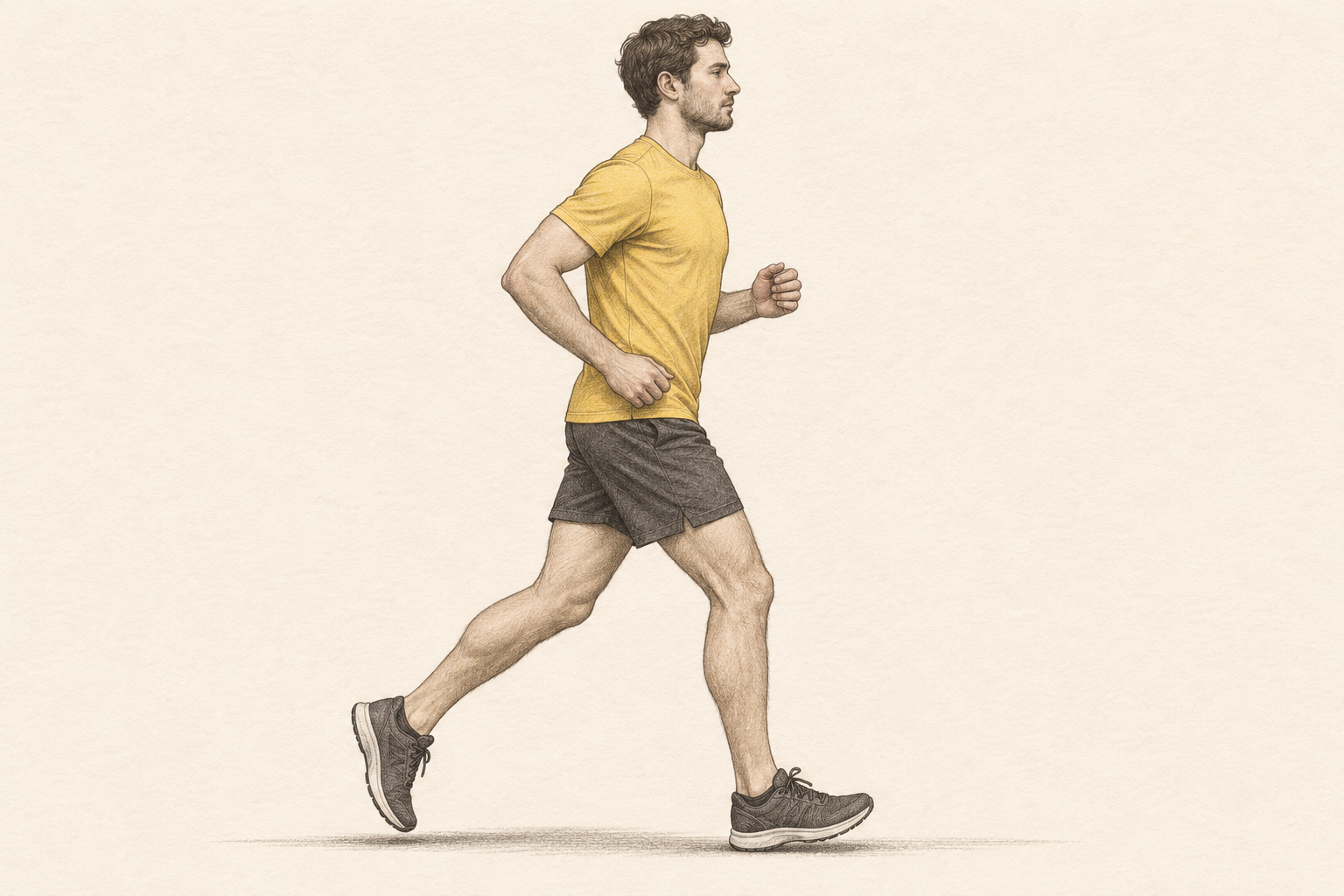
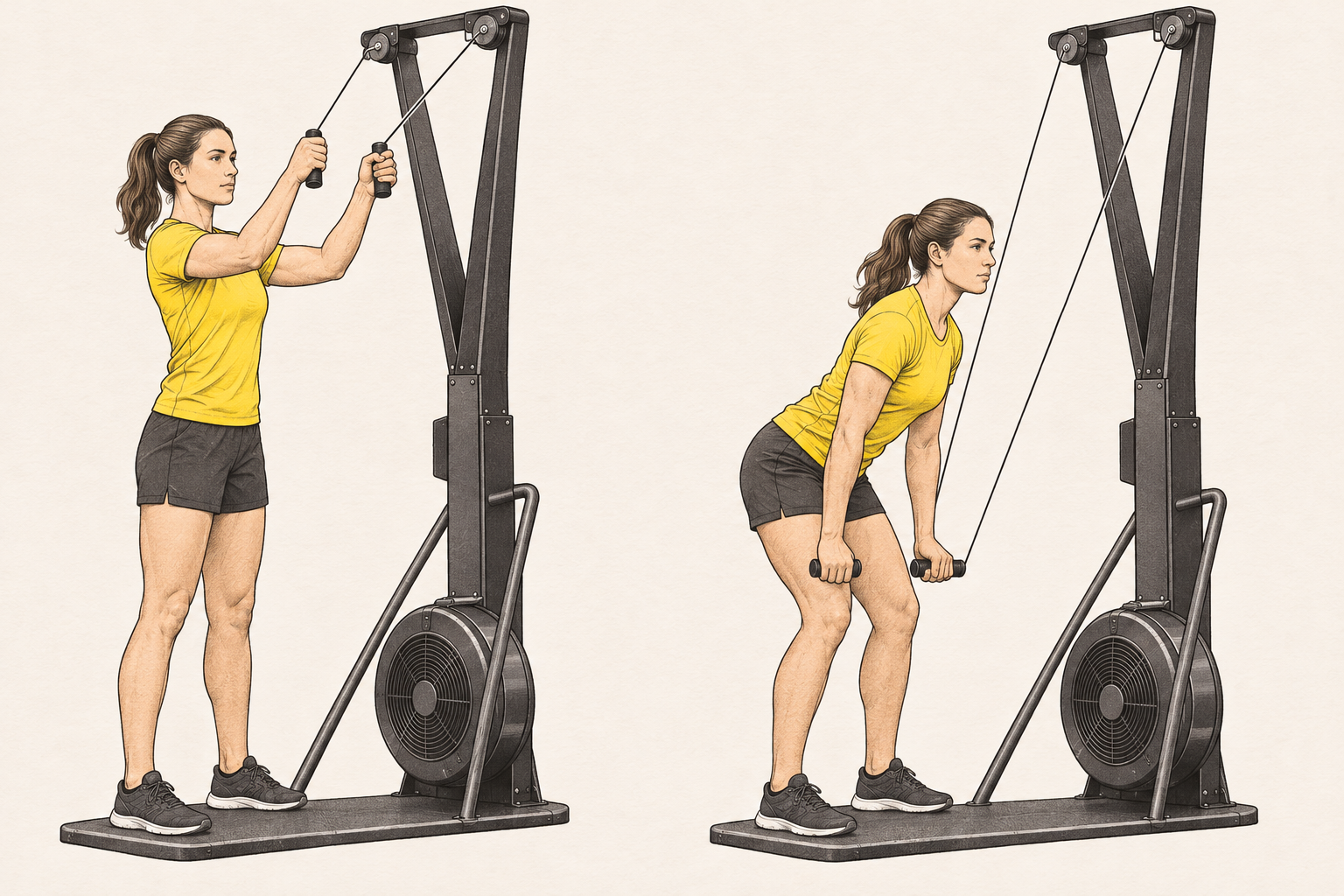
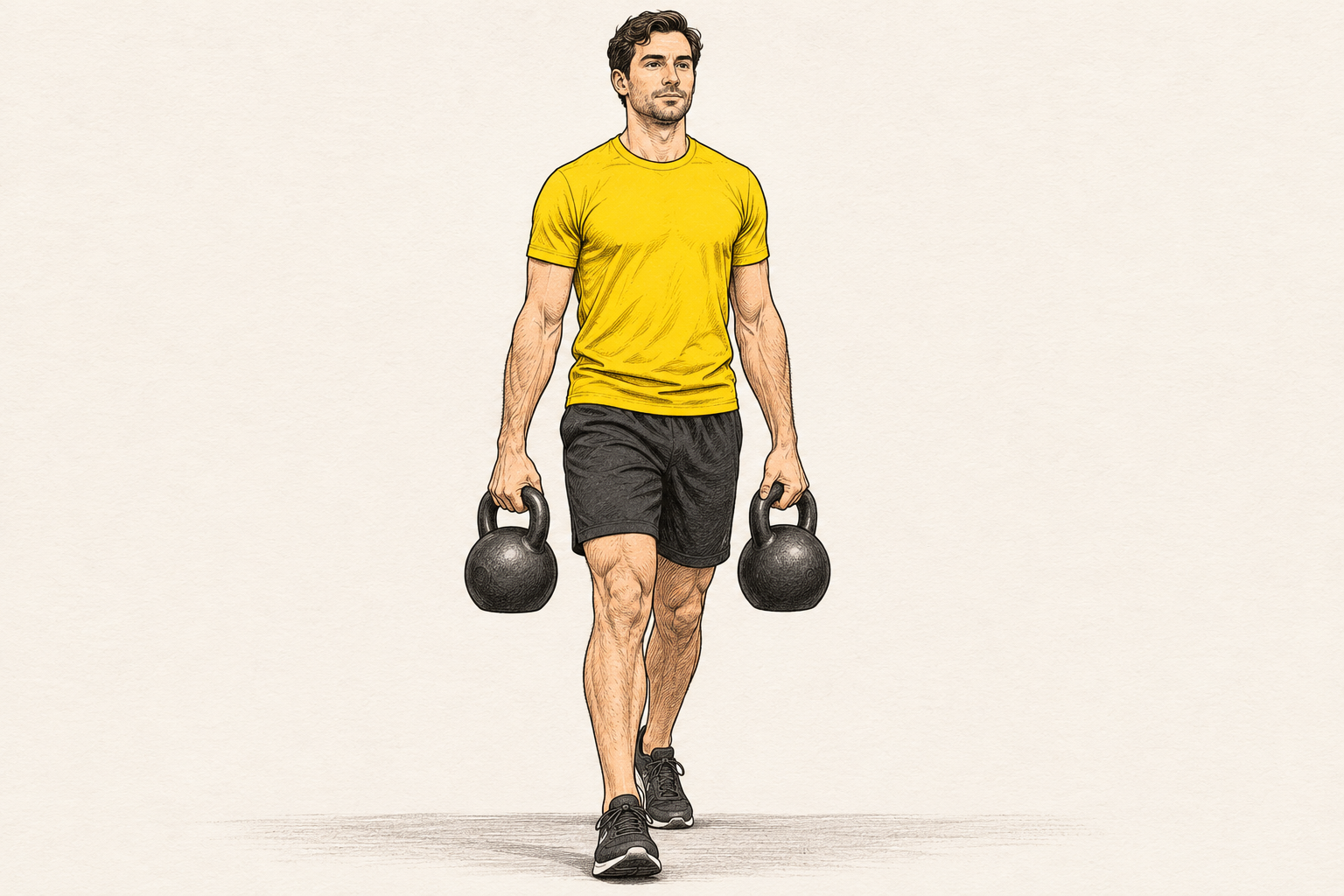
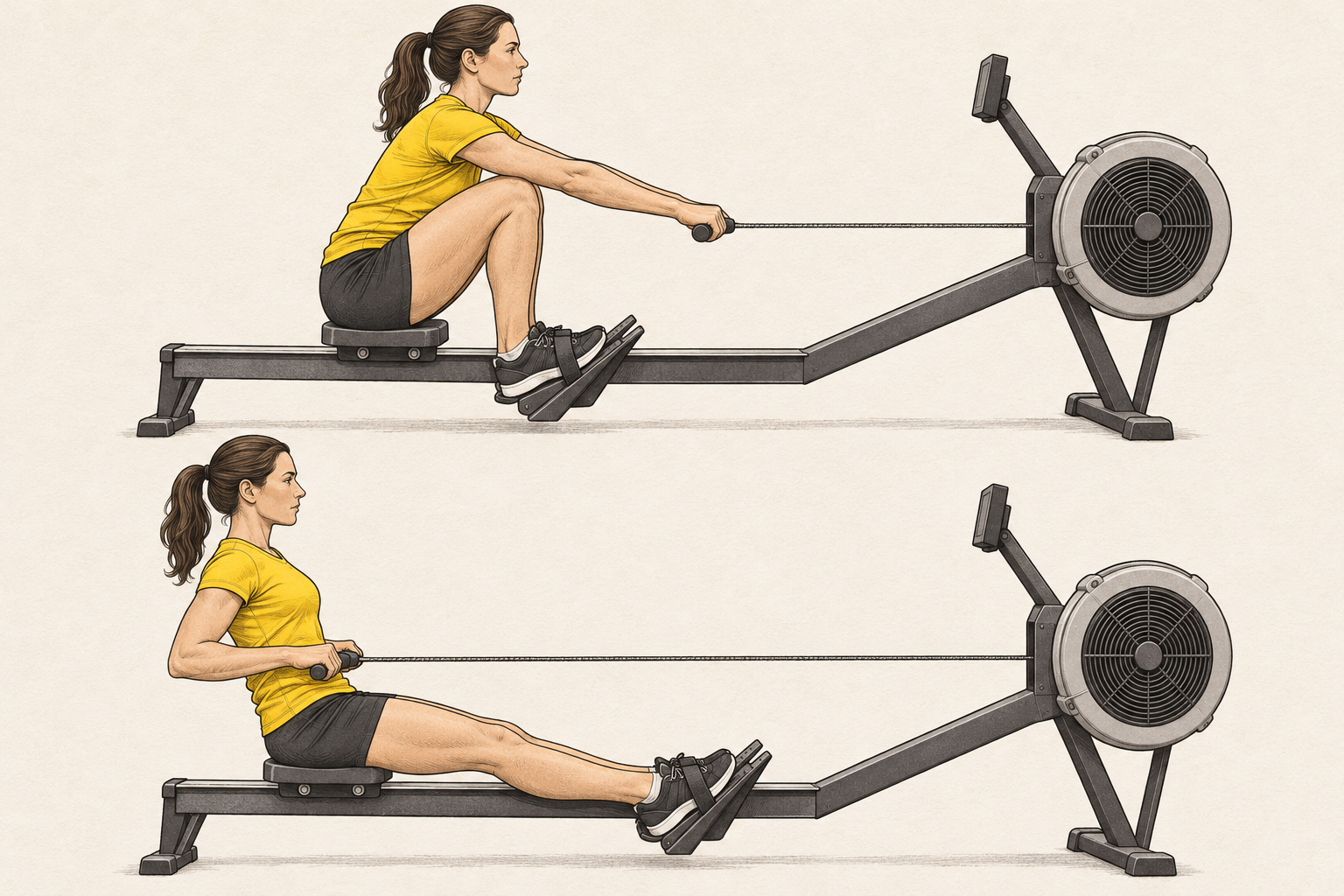
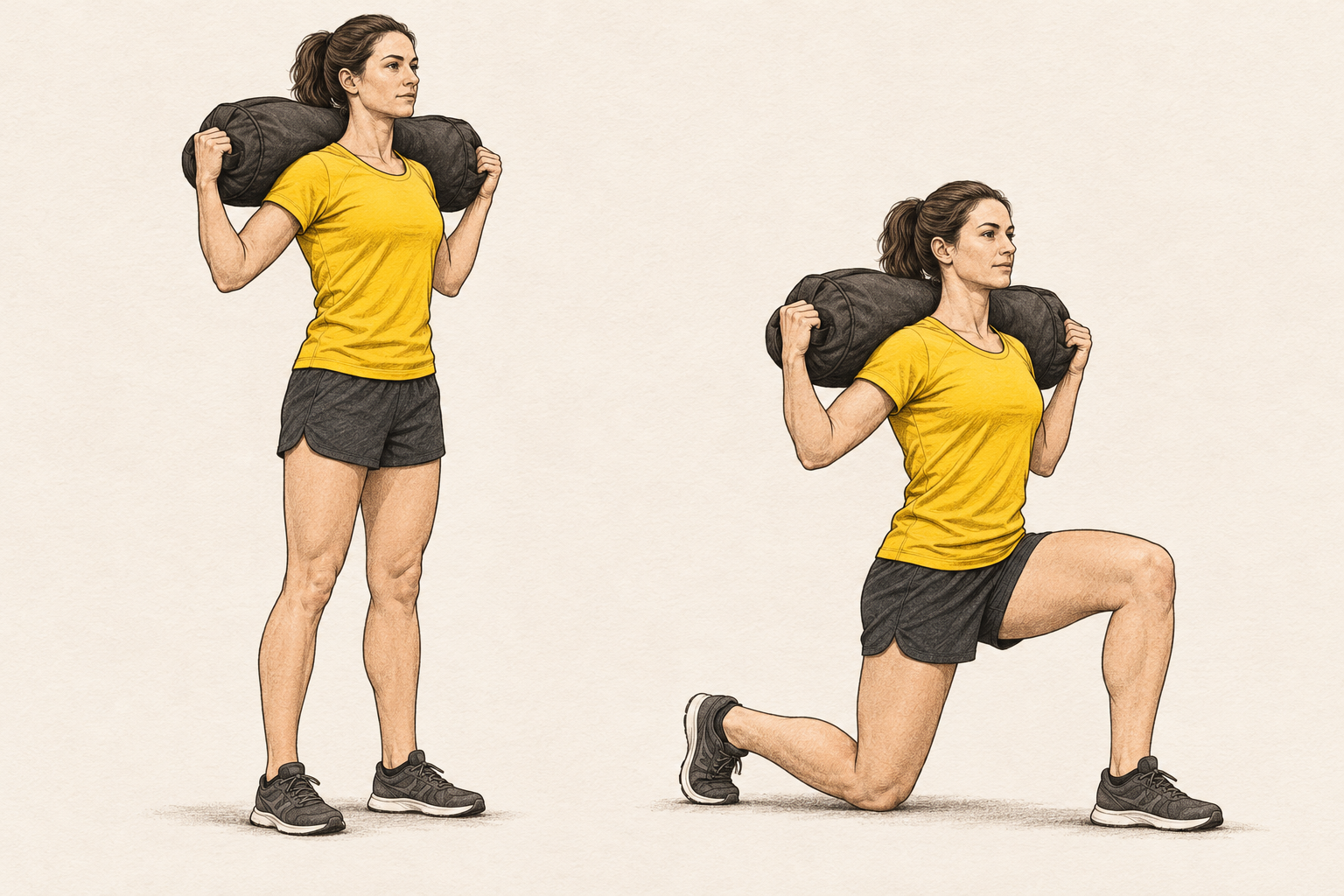
Instructional illustration of walking lunges with a sandbag supported across both shoulders.Illustration of comfortable jogging with relaxed, controlled movement.Illustration of controlled pulling on a SkiErg.Illustration of a farmers carry with one weight in each hand.Illustration of rowing technique on a rowing ergometer.
Open an image for the full-size view.

Leg work directly into running

20 min

4 rounds · all movements in the order shown

  1. 01
    Sandbag lunge

    4 rounds · 15 m · 1 min cap

    Rest: Next movement; changeover inside the cap

  2. 02
    Controlled running

    4 rounds · 400 m · 2 min 30 sec cap

    Rest: 1 min 30 sec after the round

Recovery / round structureEach round allocates 3 min 30 sec to work windows/changeovers and 1 min 30 sec to scheduled recovery. A repetition/distance window is a cap, not a predicted finish time: complete the target or stop at its cap. Use unused window time for setup/recovery; no bonus repetitions or rounds. The final recovery is included.

Different erg and carry sequence

15 min

3 rounds · all movements in the order shown

  1. 01
    SkiErg

    3 rounds · 250 m · 1 min 15 sec cap

    Rest: Next movement; changeover inside the cap

  2. 02
    Farmers carry

    3 rounds · 50 m · 1 min cap

    Rest: Next movement; changeover inside the cap

  3. 03
    Rowing

    3 rounds · 250 m · 1 min 15 sec cap

    Rest: 1 min 30 sec after the round

Recovery / round structureEach round allocates 3 min 30 sec to work windows/changeovers and 1 min 30 sec to scheduled recovery. A repetition/distance window is a cap, not a predicted finish time: complete the target or stop at its cap. Use unused window time for setup/recovery; no bonus repetitions or rounds. The final recovery is included.

Full workout breakdownWarm-up, technique & progression +

Warm-up

5 MIN

Fixed 5-minute progressive preparation

  1. 01
    Easy walking + movement rehearsal
    Sets / rounds
    1 block
    Reps / time
    5 min work
    Rest
    End this block
    Form cue +

    Begin easily, rehearse today's movements and use gradual practice resistance before working sets. Check the route and equipment.

REST / RECOVERY

Each round allocates 5 min to work windows/changeovers and 0 min to scheduled recovery. A repetition/distance window is a cap, not a predicted finish time: complete the target or stop at its cap. Use unused window time for setup/recovery; no bonus repetitions or rounds. The final recovery is included.

Technique & timing +
  • Respect the written movement order, work caps and recovery. Never rush repetitions or sprint to force a target into its window.
  • Timed work ends at the stated dose; reduced-week work can finish before its cap, leaving extra recovery. Repetition/distance work ends at the target or cap, whichever comes first.

Leg work directly into running

20 MIN

4 rounds · all movements in the order shown

  1. 01
    Sandbag lunge
    Movement guide ↗
    Sets / rounds
    4 rounds
    Reps / time
    15 m · 1 min cap
    Rest
    Next movement; changeover inside the cap
    Form cue +

    Use a familiar sandbag with controlled steps. Choose manageable training resistance for stable grip/posture. Reduce it if movement stalls or technique changes; no automatic race loads.

    Instructional illustration of walking lunges with a sandbag supported across both shoulders.
  2. 02
    Controlled running
    Sets / rounds
    4 rounds
    Reps / time
    400 m · 2 min 30 sec cap
    Rest
    1 min 30 sec after the round
    Form cue +

    Controlled effort. Complete the target or stop at the cap; shorten distance rather than sprinting or cutting recovery.

    Illustration of comfortable jogging with relaxed, controlled movement.
REST / RECOVERY

Each round allocates 3 min 30 sec to work windows/changeovers and 1 min 30 sec to scheduled recovery. A repetition/distance window is a cap, not a predicted finish time: complete the target or stop at its cap. Use unused window time for setup/recovery; no bonus repetitions or rounds. The final recovery is included.

Technique & timing +
  • Respect the written movement order, work caps and recovery. Never rush repetitions or sprint to force a target into its window.
  • Timed work ends at the stated dose; reduced-week work can finish before its cap, leaving extra recovery. Repetition/distance work ends at the target or cap, whichever comes first.

Different erg and carry sequence

15 MIN

3 rounds · all movements in the order shown

  1. Sets / rounds
    3 rounds
    Reps / time
    250 m · 1 min 15 sec cap
    Rest
    Next movement; changeover inside the cap
    Form cue +

    Repeatable training pace. Stop at the target or cap; no fixed race split is inferred from the quiz.

    Illustration of controlled pulling on a SkiErg.
  2. 02
    Farmers carry
    Movement guide ↗
    Sets / rounds
    3 rounds
    Reps / time
    50 m · 1 min cap
    Rest
    Next movement; changeover inside the cap
    Form cue +

    Dumbbells or kettlebells. Choose manageable training resistance for stable grip/posture. Reduce it if movement stalls or technique changes; no automatic race loads.

    Illustration of a farmers carry with one weight in each hand.
  3. Sets / rounds
    3 rounds
    Reps / time
    250 m · 1 min 15 sec cap
    Rest
    1 min 30 sec after the round
    Form cue +

    Repeatable training pace. Stop at the target or cap; no fixed race split is inferred from the quiz.

    Illustration of rowing technique on a rowing ergometer.
REST / RECOVERY

Each round allocates 3 min 30 sec to work windows/changeovers and 1 min 30 sec to scheduled recovery. A repetition/distance window is a cap, not a predicted finish time: complete the target or stop at its cap. Use unused window time for setup/recovery; no bonus repetitions or rounds. The final recovery is included.

Technique & timing +
  • Respect the written movement order, work caps and recovery. Never rush repetitions or sprint to force a target into its window.
  • Timed work ends at the stated dose; reduced-week work can finish before its cap, leaving extra recovery. Repetition/distance work ends at the target or cap, whichever comes first.

Cooldown

5 MIN

Fixed 5-minute cooldown

  1. 01
    Easy walking + session review
    Sets / rounds
    1 block
    Reps / time
    5 min work
    Rest
    End this block
    Form cue +

    Let breathing settle; record actual work, effort and recovery. Finish early if needed rather than forcing the clock.

REST / RECOVERY

Each round allocates 5 min to work windows/changeovers and 0 min to scheduled recovery. A repetition/distance window is a cap, not a predicted finish time: complete the target or stop at its cap. Use unused window time for setup/recovery; no bonus repetitions or rounds. The final recovery is included.

Technique & timing +
  • Respect the written movement order, work caps and recovery. Never rush repetitions or sprint to force a target into its window.
  • Timed work ends at the stated dose; reduced-week work can finish before its cap, leaving extra recovery. Repetition/distance work ends at the target or cap, whichever comes first.

Equipment & adaptation

Familiar training equipment and suitable loads/targets; no race load is inferred. Targets are capped; no mandatory finish pace is inferred. Longer appointments add different 15-minute modules; retained work and recovery never change with the duration selector.

Progression

Establish and record this authored working dose. Repeat or simplify the preceding dose if it was not manageable; progression is conditional, never automatic. Stop if discomfort changes movement. The appointment is an upper limit, not forced completion.
SAMPLE WORKOUT 02

Push, run, row

Link measured station work and running in a substantial repeatable sequence.

45 min · Warm-up and cooldown includedControlled race-specific work · about 6–8 out of 10
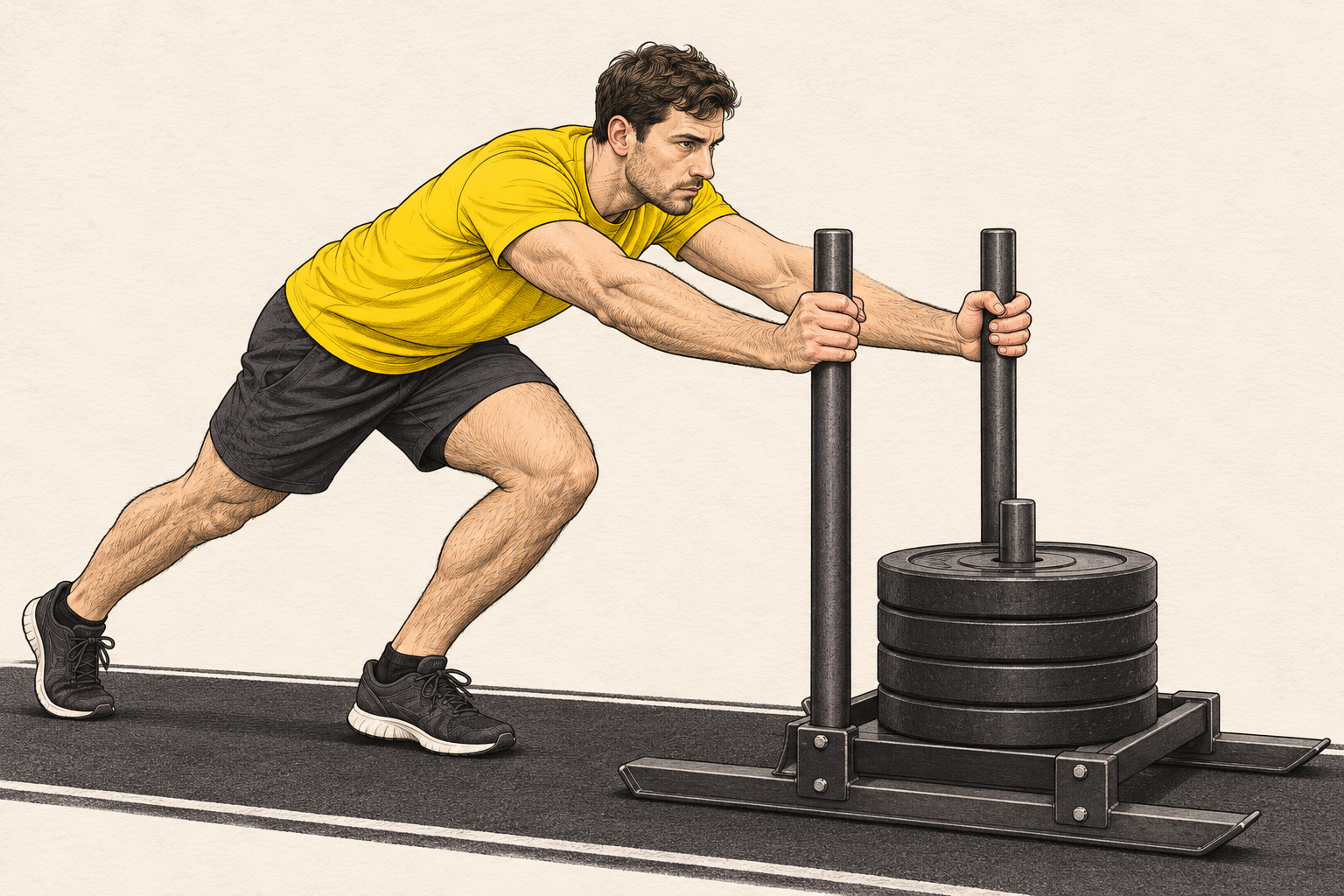
Illustration of a sled push with hands on the sled poles.Illustration of comfortable jogging with relaxed, controlled movement.Illustration of rowing technique on a rowing ergometer.Illustration of a farmers carry with one weight in each hand.Instructional illustration of walking lunges with a sandbag supported across both shoulders.Illustration of the wall-ball squat and throw.
Open an image for the full-size view.

Push / alternative → run → row / alternative

20 min

4 rounds · all movements in the order shown

  1. 01
    Sled push

    4 rounds · 12.5 m · 1 min cap

    Rest: Next movement; changeover inside the cap

  2. 02
    Controlled running

    4 rounds · 400 m · 2 min cap

    Rest: Next movement; changeover inside the cap

  3. 03
    Rowing

    4 rounds · 250 m · 1 min cap

    Rest: 1 min after the round

Recovery / round structureEach round allocates 4 min to work windows/changeovers and 1 min to scheduled recovery. A repetition/distance window is a cap, not a predicted finish time: complete the target or stop at its cap. Use unused window time for setup/recovery; no bonus repetitions or rounds. The final recovery is included.

Different loaded-station group

15 min

3 rounds · all movements in the order shown

  1. 01
    Farmers carry

    3 rounds · 50 m · 1 min cap

    Rest: Next movement; changeover inside the cap

  2. 02
    Sandbag lunge

    3 rounds · 15 m · 1 min cap

    Rest: Next movement; changeover inside the cap

  3. 03
    Wall ball

    3 rounds · 15 reps · 1 min cap

    Rest: 2 min after the round

Recovery / round structureEach round allocates 3 min to work windows/changeovers and 2 min to scheduled recovery. A repetition/distance window is a cap, not a predicted finish time: complete the target or stop at its cap. Use unused window time for setup/recovery; no bonus repetitions or rounds. The final recovery is included.

Full workout breakdownWarm-up, technique & progression +

Warm-up

5 MIN

Fixed 5-minute progressive preparation

  1. 01
    Easy walking + movement rehearsal
    Sets / rounds
    1 block
    Reps / time
    5 min work
    Rest
    End this block
    Form cue +

    Begin easily, rehearse today's movements and use gradual practice resistance before working sets. Check the route and equipment.

REST / RECOVERY

Each round allocates 5 min to work windows/changeovers and 0 min to scheduled recovery. A repetition/distance window is a cap, not a predicted finish time: complete the target or stop at its cap. Use unused window time for setup/recovery; no bonus repetitions or rounds. The final recovery is included.

Technique & timing +
  • Respect the written movement order, work caps and recovery. Never rush repetitions or sprint to force a target into its window.
  • Timed work ends at the stated dose; reduced-week work can finish before its cap, leaving extra recovery. Repetition/distance work ends at the target or cap, whichever comes first.

Push / alternative → run → row / alternative

20 MIN

4 rounds · all movements in the order shown

  1. Sets / rounds
    4 rounds
    Reps / time
    12.5 m · 1 min cap
    Rest
    Next movement; changeover inside the cap
    Form cue +

    Choose manageable training resistance for stable grip/posture. Reduce it if movement stalls or technique changes; no automatic race loads.

    Illustration of a sled push with hands on the sled poles.
  2. 02
    Controlled running
    Sets / rounds
    4 rounds
    Reps / time
    400 m · 2 min cap
    Rest
    Next movement; changeover inside the cap
    Form cue +

    Controlled effort. Complete the target or stop at the cap; shorten distance rather than sprinting or cutting recovery.

    Illustration of comfortable jogging with relaxed, controlled movement.
  3. Sets / rounds
    4 rounds
    Reps / time
    250 m · 1 min cap
    Rest
    1 min after the round
    Form cue +

    Repeatable training pace. Stop at the target or cap; no fixed race split is inferred from the quiz.

    Illustration of rowing technique on a rowing ergometer.
REST / RECOVERY

Each round allocates 4 min to work windows/changeovers and 1 min to scheduled recovery. A repetition/distance window is a cap, not a predicted finish time: complete the target or stop at its cap. Use unused window time for setup/recovery; no bonus repetitions or rounds. The final recovery is included.

Technique & timing +
  • Respect the written movement order, work caps and recovery. Never rush repetitions or sprint to force a target into its window.
  • Timed work ends at the stated dose; reduced-week work can finish before its cap, leaving extra recovery. Repetition/distance work ends at the target or cap, whichever comes first.

Different loaded-station group

15 MIN

3 rounds · all movements in the order shown

  1. 01
    Farmers carry
    Movement guide ↗
    Sets / rounds
    3 rounds
    Reps / time
    50 m · 1 min cap
    Rest
    Next movement; changeover inside the cap
    Form cue +

    Dumbbells or kettlebells. Choose manageable training resistance for stable grip/posture. Reduce it if movement stalls or technique changes; no automatic race loads.

    Illustration of a farmers carry with one weight in each hand.
  2. 02
    Sandbag lunge
    Movement guide ↗
    Sets / rounds
    3 rounds
    Reps / time
    15 m · 1 min cap
    Rest
    Next movement; changeover inside the cap
    Form cue +

    Use a familiar sandbag with controlled steps. Choose manageable training resistance for stable grip/posture. Reduce it if movement stalls or technique changes; no automatic race loads.

    Instructional illustration of walking lunges with a sandbag supported across both shoulders.
  3. Sets / rounds
    3 rounds
    Reps / time
    15 reps · 1 min cap
    Rest
    2 min after the round
    Form cue +

    Suitable training ball and target; keep repetitions clean. Race weight/height are not inferred.

    Illustration of the wall-ball squat and throw.
REST / RECOVERY

Each round allocates 3 min to work windows/changeovers and 2 min to scheduled recovery. A repetition/distance window is a cap, not a predicted finish time: complete the target or stop at its cap. Use unused window time for setup/recovery; no bonus repetitions or rounds. The final recovery is included.

Technique & timing +
  • Respect the written movement order, work caps and recovery. Never rush repetitions or sprint to force a target into its window.
  • Timed work ends at the stated dose; reduced-week work can finish before its cap, leaving extra recovery. Repetition/distance work ends at the target or cap, whichever comes first.

Cooldown

5 MIN

Fixed 5-minute cooldown

  1. 01
    Easy walking + session review
    Sets / rounds
    1 block
    Reps / time
    5 min work
    Rest
    End this block
    Form cue +

    Let breathing settle; record actual work, effort and recovery. Finish early if needed rather than forcing the clock.

REST / RECOVERY

Each round allocates 5 min to work windows/changeovers and 0 min to scheduled recovery. A repetition/distance window is a cap, not a predicted finish time: complete the target or stop at its cap. Use unused window time for setup/recovery; no bonus repetitions or rounds. The final recovery is included.

Technique & timing +
  • Respect the written movement order, work caps and recovery. Never rush repetitions or sprint to force a target into its window.
  • Timed work ends at the stated dose; reduced-week work can finish before its cap, leaving extra recovery. Repetition/distance work ends at the target or cap, whichever comes first.

Equipment & adaptation

Familiar training equipment and suitable loads/targets; no race load is inferred. Targets are capped; no mandatory finish pace is inferred. Longer appointments add different 15-minute modules; retained work and recovery never change with the duration selector.

Progression

Establish and record this authored working dose. Repeat or simplify the preceding dose if it was not manageable; progression is conditional, never automatic. Stop if discomfort changes movement. The appointment is an upper limit, not forced completion.

SAMPLE WORKOUT 03

Wall-ball rhythm, then running

Build repeatable wall-ball capacity and connect it to a separate running block.

45 min · Warm-up and cooldown includedControlled capacity · about 6–8 out of 10
Illustration of the wall-ball squat and throw.Illustration of comfortable jogging with relaxed, controlled movement.Illustration of rowing technique on a rowing ergometer.Illustration of a farmers carry with one weight in each hand.Instructional illustration of walking lunges with a sandbag supported across both shoulders.
Open an image for the full-size view.

Wall-ball minute starts

10 min

EMOM · 10 minute-starts, one task each minute

  1. 01
    Wall ball

    10 minute-starts · 10 reps · 1 min cap

    Rest: Remainder of each minute; restart on the next minute

Recovery / round structureComplete the repetition target early enough to recover before the next minute. Rest for the remaining minute; there is no fixed 30-second rest. If the target does not leave recovery, lower repetitions. Ten starts total; no additional sets.

Running after capacity work

10 min

One continuous block

  1. 01
    Controlled running

    1 block · 10 min work

    Rest: End this block

Recovery / round structureEach round allocates 10 min to work windows/changeovers and 0 min to scheduled recovery. A repetition/distance window is a cap, not a predicted finish time: complete the target or stop at its cap. Use unused window time for setup/recovery; no bonus repetitions or rounds. The final recovery is included.

Different erg and loaded-station group

15 min

3 rounds · all movements in the order shown

  1. 01
    Rowing

    3 rounds · 250 m · 1 min cap

    Rest: Next movement; changeover inside the cap

  2. 02
    Farmers carry

    3 rounds · 50 m · 1 min cap

    Rest: Next movement; changeover inside the cap

  3. 03
    Sandbag lunge

    3 rounds · 15 m · 1 min cap

    Rest: 2 min after the round

Recovery / round structureEach round allocates 3 min to work windows/changeovers and 2 min to scheduled recovery. A repetition/distance window is a cap, not a predicted finish time: complete the target or stop at its cap. Use unused window time for setup/recovery; no bonus repetitions or rounds. The final recovery is included.

Full workout breakdownWarm-up, technique & progression +

Warm-up

5 MIN

Fixed 5-minute progressive preparation

  1. 01
    Easy walking + movement rehearsal
    Sets / rounds
    1 block
    Reps / time
    5 min work
    Rest
    End this block
    Form cue +

    Begin easily, rehearse today's movements and use gradual practice resistance before working sets. Check the route and equipment.

REST / RECOVERY

Each round allocates 5 min to work windows/changeovers and 0 min to scheduled recovery. A repetition/distance window is a cap, not a predicted finish time: complete the target or stop at its cap. Use unused window time for setup/recovery; no bonus repetitions or rounds. The final recovery is included.

Technique & timing +
  • Respect the written movement order, work caps and recovery. Never rush repetitions or sprint to force a target into its window.
  • Timed work ends at the stated dose; reduced-week work can finish before its cap, leaving extra recovery. Repetition/distance work ends at the target or cap, whichever comes first.

Wall-ball minute starts

10 MIN

EMOM · 10 minute-starts, one task each minute

  1. Sets / rounds
    10 minute-starts
    Reps / time
    10 reps · 1 min cap
    Rest
    Remainder of each minute; restart on the next minute
    Form cue +

    The first familiar full-gym week uses Weeks's published minute-start pattern. Choose a suitable ball/target; altered counts are HiRox scaling.

    Illustration of the wall-ball squat and throw.
REST / RECOVERY

Complete the repetition target early enough to recover before the next minute. Rest for the remaining minute; there is no fixed 30-second rest. If the target does not leave recovery, lower repetitions. Ten starts total; no additional sets.

Technique & timing +
  • This is a ten-minute EMOM, not ten independent long strength sets. Do the task once each minute and rest until the next start.
  • The work window includes its variable remaining-minute recovery; no extra rest time is added outside it.

Running after capacity work

10 MIN

One continuous block

  1. 01
    Controlled running
    Sets / rounds
    1 block
    Reps / time
    10 min work
    Rest
    End this block
    Form cue +

    Use the stated timed dose, log meters and keep a repeatable effort. No distance target ends the interval early; use any unused cap as easy recovery.

    Illustration of comfortable jogging with relaxed, controlled movement.
REST / RECOVERY

Each round allocates 10 min to work windows/changeovers and 0 min to scheduled recovery. A repetition/distance window is a cap, not a predicted finish time: complete the target or stop at its cap. Use unused window time for setup/recovery; no bonus repetitions or rounds. The final recovery is included.

Technique & timing +
  • Respect the written movement order, work caps and recovery. Never rush repetitions or sprint to force a target into its window.
  • Timed work ends at the stated dose; reduced-week work can finish before its cap, leaving extra recovery. Repetition/distance work ends at the target or cap, whichever comes first.

Different erg and loaded-station group

15 MIN

3 rounds · all movements in the order shown

  1. Sets / rounds
    3 rounds
    Reps / time
    250 m · 1 min cap
    Rest
    Next movement; changeover inside the cap
    Form cue +

    Repeatable training pace. Stop at the target or cap; no fixed race split is inferred from the quiz.

    Illustration of rowing technique on a rowing ergometer.
  2. 02
    Farmers carry
    Movement guide ↗
    Sets / rounds
    3 rounds
    Reps / time
    50 m · 1 min cap
    Rest
    Next movement; changeover inside the cap
    Form cue +

    Dumbbells or kettlebells. Choose manageable training resistance for stable grip/posture. Reduce it if movement stalls or technique changes; no automatic race loads.

    Illustration of a farmers carry with one weight in each hand.
  3. 03
    Sandbag lunge
    Movement guide ↗
    Sets / rounds
    3 rounds
    Reps / time
    15 m · 1 min cap
    Rest
    2 min after the round
    Form cue +

    Use a familiar sandbag with controlled steps. Choose manageable training resistance for stable grip/posture. Reduce it if movement stalls or technique changes; no automatic race loads.

    Instructional illustration of walking lunges with a sandbag supported across both shoulders.
REST / RECOVERY

Each round allocates 3 min to work windows/changeovers and 2 min to scheduled recovery. A repetition/distance window is a cap, not a predicted finish time: complete the target or stop at its cap. Use unused window time for setup/recovery; no bonus repetitions or rounds. The final recovery is included.

Technique & timing +
  • Respect the written movement order, work caps and recovery. Never rush repetitions or sprint to force a target into its window.
  • Timed work ends at the stated dose; reduced-week work can finish before its cap, leaving extra recovery. Repetition/distance work ends at the target or cap, whichever comes first.

Cooldown

5 MIN

Fixed 5-minute cooldown

  1. 01
    Easy walking + session review
    Sets / rounds
    1 block
    Reps / time
    5 min work
    Rest
    End this block
    Form cue +

    Let breathing settle; record actual work, effort and recovery. Finish early if needed rather than forcing the clock.

REST / RECOVERY

Each round allocates 5 min to work windows/changeovers and 0 min to scheduled recovery. A repetition/distance window is a cap, not a predicted finish time: complete the target or stop at its cap. Use unused window time for setup/recovery; no bonus repetitions or rounds. The final recovery is included.

Technique & timing +
  • Respect the written movement order, work caps and recovery. Never rush repetitions or sprint to force a target into its window.
  • Timed work ends at the stated dose; reduced-week work can finish before its cap, leaving extra recovery. Repetition/distance work ends at the target or cap, whichever comes first.

Equipment & adaptation

Familiar training equipment and suitable loads/targets; no race load is inferred. Targets are capped; no mandatory finish pace is inferred. Longer appointments add different 15-minute modules; retained work and recovery never change with the duration selector.

Progression

Establish and record this authored working dose. Repeat or simplify the preceding dose if it was not manageable; progression is conditional, never automatic. Stop if discomfort changes movement. The appointment is an upper limit, not forced completion.

Understand Complete.Read the full guide +

Train race-specific running connections and mixed station conditioning. Link substantial tasks at a purposeful effort, with recovery matched to the actual workout.

Connect the tasks under a real training demand

HYROX365 describes Complete as its most race-specific format. Running sequences connect a meaningful station task with the next run; station-conditioning sessions develop capacity across several familiar movements. Both can be demanding work for an established athlete. Unfamiliar equipment still belongs in separate skill practice first.

Foundational develops the broad base, Engine develops conditioning and Power develops resistance capacity. Complete connects those qualities. It is not a certificate of race readiness, and a shorter adapted session does not become a full race simulation simply because it includes several station names.

Learn from a champion's pattern and read our adaptation

Concept2 attributes a paired workout to Meg Jacoby: 10 sets of 500 m rowing followed immediately by 15 burpees over the rower, then 90 seconds recovery. Its grouping matters: the recovery follows the pair. Our shorter, capped combinations are HiRox adaptations, with their own stated movements and doses; they are not her exact session.

A useful mixed session has a purpose beyond collecting station names. Practise how one task affects the next run or movement, and preserve the recovery assigned to the whole group. Dedicated station conditioning can develop mixed movement capacity; keep running elsewhere in the week when the selected block has no running segment.

  • Run–station–run: settle into useful running after a station rather than ending the workout at the station.
  • Station conditioning: follow the timed rotation and its recovery; this supports station capacity without claiming a running segment.
  • Progression: compare completed rounds, transition quality and pace at the intended effort before adding more work.

Preserve the task while admitting the limits of a substitute

The 30-minute option includes the core block, preparation and cooldown. At 45 minutes, add a separate 15-minute movement block; at 60 minutes, include a second addition. Shared exercises keep the same sets, repetitions or distance, work windows and recovery across duration choices. Keep the core's prescribed rounds while completing the distinct movements shown in each added block.

A full gym can reproduce the actual erg, sled and loaded movement setup. A basic gym can support running with free-weight station adaptations; minimal-equipment work can connect bodyweight tasks with run–walk portions. These can be useful sessions without reproducing every demand of the race.

Use the exact exercise named in your displayed version. A step-back burpee is a different task from jumping over an erg, and a dumbbell row is a different task from rowing. The current season's race standards remain in the separate movement guide. Training sources inspire the session structure; the rulebook defines competition requirements.

Measure the sequence across a recoverable week

For a running sequence, record the quality of the second run as well as the preceding station. For a station rotation, compare the work and movement quality across successive stations. Notice where breathing, grip or technique begins to change, then compare the same workout on its next appearance. The source pattern gives the work shape; the stated adaptation keeps it within your actual session window.

Meg's published race advice weighs a station's output against the run that follows. The RMR post-race discussion also treats repeatable execution as meaningful progress. Keep easy aerobic work and recovery between demanding sessions. Our four-week schedule, movement modules and progression are HiRox adaptations inspired by these principles, without a claim of athlete endorsement or a particular finish time.

Common mistakes

  • Calling a few seconds of station work followed by long rest a race-specific sequence.
  • Replacing meaningful running with an arbitrary tiny dose for every athlete.
  • Compressing the source's full workout into a shorter claimed duration without changing its work.
  • Adding extra hard days because one mixed session felt successful.

Sources and further reading

Source-based workouts with explicit HiRox adaptations. HiRox is independent of HYROX. Check the current official rulebook and your event briefing for race requirements.

HIROX / TRAINING

Loading your training quiz…

Your answers stay in this page and reset when you reload. The result is an educational sample schedule, not an assessment of race readiness.